
Geoinvestigate launches mine shaft and sinkhole helpline in Newcastle.

Mineshaft and sinkhole helpline Newcastle was created by Geoinvestigate to assist the public seeking information and advice on Mine Shaft Hazard (MSH) and sinkhole hazard. It is specifically targeted at the house conveyancing market and sellers and buyers but is also useful for builder, developers, planners, property agents, insurers and lenders dealing with mine shaft and sinkhole hazard.
Please contact our telephone helpline on free call 0800 1712011 or email geoinvestigate @qnetadsl.com for help and advice from experts.
The following article is provided to give those involved with mine shaft and sinkhole hazard some general background to the problem and how it is investigated and remediated. It touches upon the issues created by the recent introduction of risk assessment into the house conveyancing market. Its main focus is mine shaft hazard which can result in sales falling through at the last minute and buyers being unable to get mortgages on properties affected by MSH. The article is split into 12 sections
- How we can help
- About mine shafts
- How big is the problem?
- Your stories
- Who pays?
- Finding mine shafts
1 We can help
While we cannot promise to answer all your question and provide a successful outcome for each enquiry Geoinvestigate can help in several ways
- We can listen to your problems and advise you about what to do next
- Tell you about the pitfalls and the likelihood of a successful outcome
- We can better assess the risk to your property from mine shaft and sinkhole hazard by reviewing old maps, mining and borehole records. There will however be a professional fee if you use choose this or any of the specialist services we provide below.
- We can try to locate the mine entry on your property by excavation, drilling or other techniques.
- If the mine entry is found, we can with additional investigation better establish if the feature is stable or potentially unsafe in which case the Coal Authority becomes liable and must step up to the plate and fix the problem out of their own pocket.
- We can advise you if there is justification for a claim against the mine search indemnity attached to the original mining report you obtained. This is currently set at £50,000 in addition to the CAs liability to make safe the ground and repair any building damage caused by mine working instability. The indemnity will be less the older the report is. In 2006 it was £20,000.
- We can also point you in the direction of legal experts who may be able to assist you in a dispute.
2 About mine shafts

- Collapse of probable coal mine shaft in 2017. Evidence of driveway subsidence was visible in 2016
This year Geoinvestigate has dealt with more calls and emails about mine shaft and sinkhole hazard than in any previous year. We have been told about mine shafts opening up in public parks and wasteland, house sales falling through at the very last minute because of mine shafts and homeowners discovering that they may have mine shafts under their homes and gardens. One very worried caller said he thought he had a mine shaft under his living room, another under her garden where the kids play.
3 How big is the problem?
The UK Coal Authority record some 150,000 coal mine shafts and other mine entrances and as many may exist again but are unrecorded or “missing”. They estimate that there are 25,000 square kilometres of abandoned underground coal mine workings and tunnels in the Britain. The number of shafts probably double when other non-coal mine entries made for the tin, copper, lead, iron, clay industries etc. are included. The total number of abandoned mine entries in the UK has been estimated at 405,000. There are on average 15 mine shaft collapses a year in the UK and up to 30 collapses of the ground caused by mining legacy.
There are 130,000 properties within 20m of a mine entry – an often bandied about measure with increasing importance today with regard to selling your home near to a mine shaft and getting a mortgage.

- Sudden collapse of tin mine shaft. The property was for sale and luckily unoccupied.
Many parts of the country where the underlying geology is Limestone, Chalk, Salt/Brine or Gypsum suffer from natural sinkhole formation posing similar hazards to mine shafts.

- Ripon, North Yorkshire. Gypsum sinkhole collapse and subsidence hazard based on BGS model
In the UK there are hazards that lie beneath our feet left over from our past and very long mining history. This dates all the way back to 3500BC and earlier when our Neolithic ancestors were mining flints from the ground for axes, arrow heads and fire starting. Following Bronze Age tin and copper mining the Romans mined lead in Cumbria, tin in Cornwall and gold in Wales. Medieval and subsequent farming practice extracted chalk on a large scale in the South of England to improve agricultural land. Sandstone and limestone has been mined extensively throughout the UK for building stone while clay and sand has been extracted for pottery and foundry bricks and linings.
Organised coal mining was occurring as early as the 13th Century steadily increasing through the 17th, 18th, 19th & 20th Centuries as the Industrial Revolution arrived and took grip in Britain. The Peak District of Derbyshire once had 25,000 lead mine shafts while in 1920 a staggering 1.2 million people were directly employed in coal mining in Britain. Coal mining reached a peak in 1970 with the extraction of an astonishing 120 million cubic metres of coal per year but has since declined. There are estimated to be a staggering 25,000 square kilometres of abandoned coal mine workings and tunnels in the UK today.
Many tens of thousands of homes in the UK either have mine shafts or sinkholes under their floors, gardens or driveways or their properties are near enough to mine entries to be blighted by them when it comes to selling. Many of our parks, woodlands, playing fields, sports grounds, roads and schools in former coalfield areas contain one or several mine shaft hazrds unbeknown to the general public using them. From time to time these mine entries collapse or reveal their presence and failing condition through ground subsidence.

- RED crosses are mine shafts recorded on the Coal Authority database. There may be many more unknown shafts
4 Your stories
For many sellers finding a mine shaft on their property or land is the beginning of a long nightmare with no foreseeable light at the end of the tunnel and with little hope of ever selling their home at a fair market value. Properties affected by mine shafts may be worth 20% to 30% less than normal market value.

- Unable to sell their house because of a mine shaft under next door. The Bickleys case later featured on Rip-Off Britain
This year Geoinvestigate has dealt with more calls and emails about mine shaft hazards than in any previous year. One caller said they were unable to sell their house even though the mine shaft was not on their land but under a neighbour’s property making the problem impossible to sort out.
This owner, unbeknown to them had several sales fall through at the very last moment because of mine shaft hazard (MSH). Their buyer’s lender (the RBS) refused them a mortgage because of the mine shaft. The couple selling the house only found out because one buyer sorry for them told them about the mine shaft to their complete surprise and horror.
The Bickleys describe being ‘prisoners’ in their home because a mine shaft in their neighbour’s property meant they couldn’t sell their own – and they have warned that countless more homeowners may be in the same boat. They believe they are the tip of the iceberg and from the large number of similar mine shaft problems Geoinvestigate has received from the public this year we believe they are right.
We have been told of Banks and Building Societies “changing the goal posts” and inexplicably withdrawing lending on properties with known mine shafts but which they had previously been happy to provide mortgages for. They had had no problem lending on these properties 10 years ago but wouldn’t lend again today even though nothing had changed. One Bank still wouldn’t lend even after an inspection by a Coal Authority surveyor of a property with a mine shaft had reported “NO PROBLEM”?
5 Who pays?
Properties affected by mine shafts may be worth 20% to 30% less than their market value and sometimes even less. Geoinvestigate has been told of price knock downs of 50K and 60K and more on homes with mine shaft problems sold to cash buyers or in auction. Sellers are disadvantaged by not being able to sell properties affected by MSH on the open market. In many cases buyers reap the financial rewards from the dire situation sellers with mine shafts find themselves in. Other properties have been withdrawn from the market because they would not sell or the owners could not afford the high cost of the mine shaft investigation and treatment needed to make them safe.
Mine shaft blight is not only about money it’s about people lives and feelings. Distressed caused by financial uncertainty as well as worry about the safety of their home and being unable to make future plans can place an intolerable emotional burden on even the strongest. Recently on TV one couple described the nightmare of being a prisoner in their own home.
It can cost a homeowner £5,000 to £15,000 plus VAT to investigate a mine shaft hidden beneath their house. Assuming the shaft is successfully located (and this is not guaranteed) then the owner is also liable for the cost of stabilising the shaft which may be upwards of £50,000 plus VAT as well as finding alternative accommodation while the work is carried out. In one case fixing a mine shaft cost cost a whopping £105,000 ten years ago.
No wonder then that one homeowner said she would be in a better position if the mine shaft under her home subsided forcing the Coal Authority to step in and cover the cost of the investigation, repairs and temporary accommodation for her family.
If investigation fails to locate a mine shaft the situation remains unresolved and the seller is no further forward, only heavily out of pocket and facing an uncertain future. Unless the mine entry has caused damage neither the Coal Authority nor the Structural Insurance company will step in to pick up the tab for the investigative work or the cost of treating and making sure the mine shaft is stable.
Owners are completely on their own unless the shaft is a problem or the property has suffered subsidence or damage as a result of it in which case of coal the Coal Authority are liable for the cost of stabilising the ground and building repair. However the CA is not liable when non-coal mining problems need to be fixed. We have been told of one instance where after inspecting a house with a mine shaft beneath it the Coal Authority advised the owners they weren’t liable because it was a sandstone shaft and not coal. A similar shaft nearby cost their neighbours £105,000 to stabilise.
Mine shafts are an endemic hazard in many parts of Scotland, England and Wales and potentially a dangerous left over from our industrial and mining past. While instances of mine shaft collapse are very rare and building damage and personal injury even rarer the results of a mine shaft collapse could be very serious if an occupied building were to be affected or the ground unexpectedly gave way under a garden, playing field or road.

- Collapse of corner of building caused by mine shaft subsidence. Building damage is rare and injuries even rarer
In 2016 a massive sinkhole which collapsed in a garden on Magdalens Road, Ripon nearly cost the life of Frances O’Neill who saved herself from falling into the deep hole at the last minute by grabbing a clothes line. Building damage is rare and injury and fatalities even rarer from mine shaft and sinkhole collapse.
-
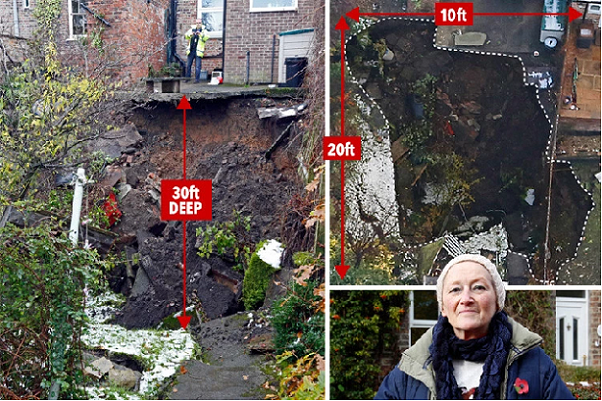
- Frances O’Neills lucky escape from falling into a gypsum sinkhole which suddenly collapsed in Ripon in 2016
Understandably for this reason mine shaft and sinkhole hazards must be treated with considerable caution and respect.
6 Finding mine shafts by excavation & drilling
In some instances Mine shafts can be found by completely stripping the topsoil or trenching at close spacing and examining the natural clay below it for the presence of a mine entry. A shaft might show up both as a localised change in colour and composition of the surface eg a patch of grey ash stoney coal waste in a sea of orange clay.
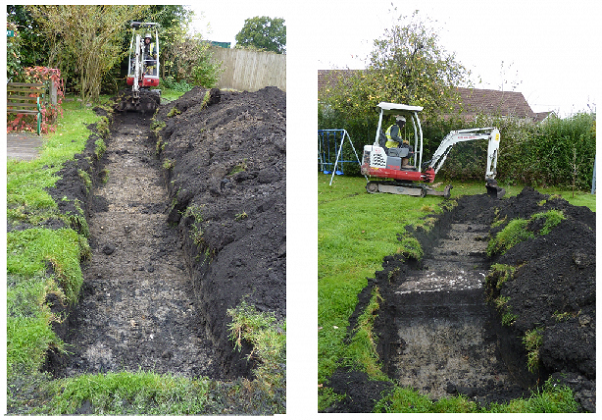
- Shallow excavation and trenching to remove topsoil and locate mine shaft in clay below. A buried concrete path is uncovered in the trench on the left
Sometimes a concrete or timber mine shaft cap might be found with the attendant risk that there remains a deep void beneath it. Where possible accidental breaking through a cap into a mine shaft should avoided for reasons of public safety. Mine shaft location by excavation becomes much more difficult where the land has subsequently been raised by infilling and the mine shaft is buried below several metres of made ground and newer buildings. Deep trenching or drilling may be appropriate in this situation but the deeper the shaft lies buried the less chance of finding it.

- Drilling with new Microdrill technology to locate shallow mine workings. Excavator in background looking for mine shafts

- Hunting for mine shafts and shallow mine workings in Bristol
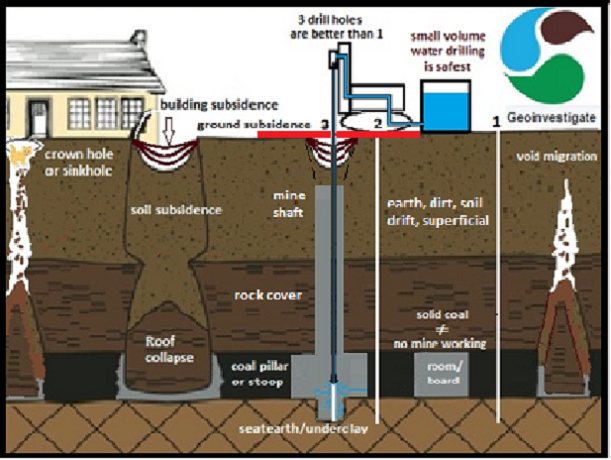
- Drilling to locate ground instability arising from mine working and mine shaft legacy
Providing the site conditions are favourable and there is no interference nearby activites and objects non intrusive geophysical (geophizz) methods including electromagnetic and microgravity survey and ground and aerial drone GPR may help locate targets quickly without the need to disturb the ground. Suitable sites are typically level, distant from walls, buildings and roads and underground services and made ground is absent. Even where geophizz has been successful excavation and/or drilling will be required to confirm which of several targets is actually shaft and to enable treatment works.
Like mine risk assessment Geofizz cannot provide certainty with regard to mine shaft location, condition and whether or not a shaft is liable to collapse and what risk level it poses currently – as mentioned on BBC Rip-Off Britain only intrusive investigation and inspection will do this.
If need advice on mine shaft or sinkhole hazard or you need a mine shaft or sinkhole investigation contact the experts at Geoinvestigate
